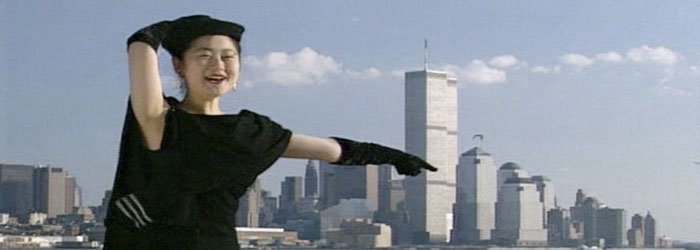
New York/Vienna 1996 short film/tv spot 2×45 sec
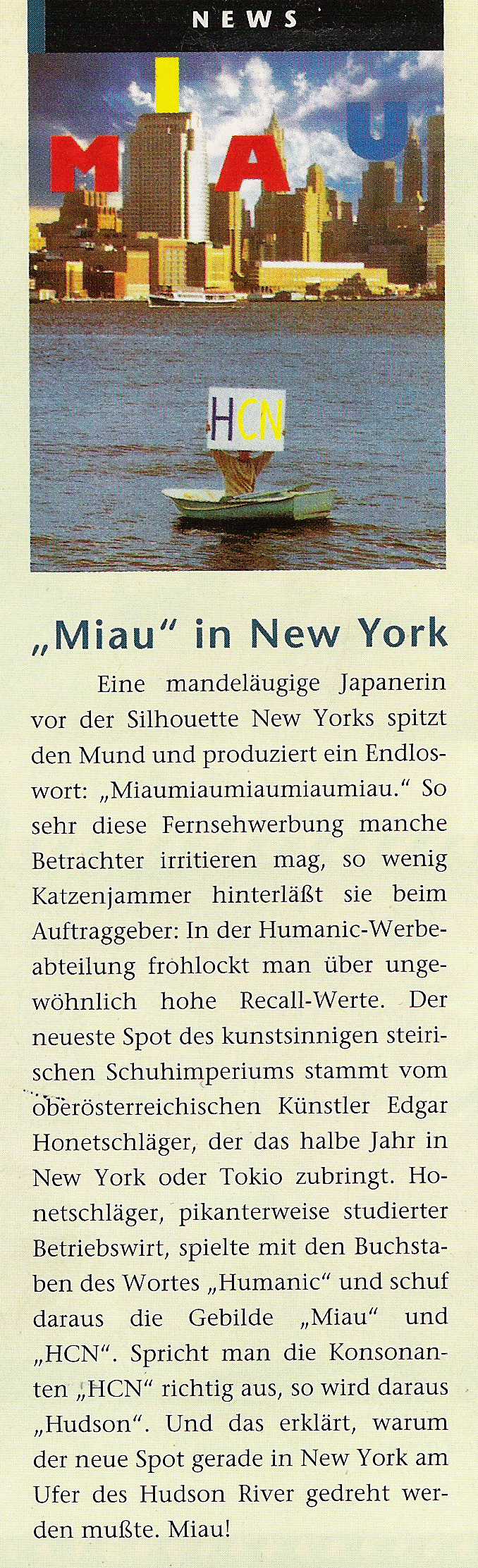
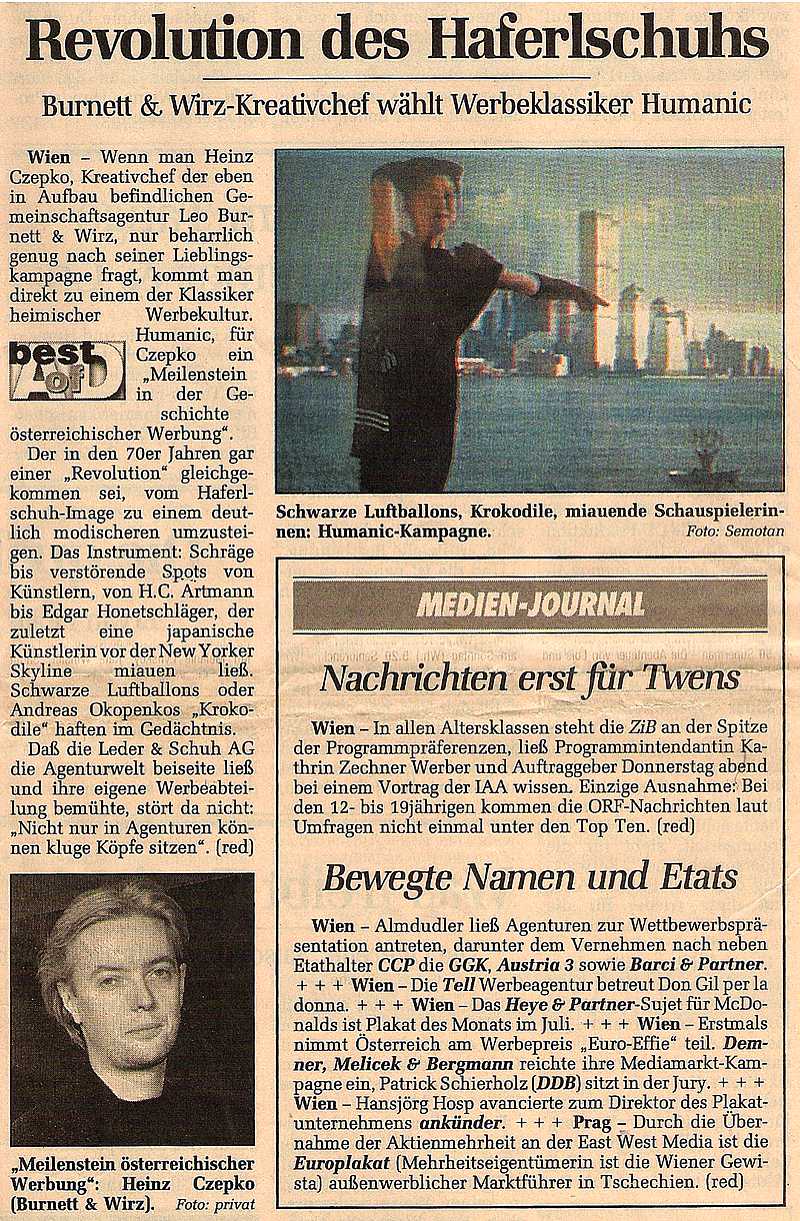
HCN MIAU is a commercial commissioned by the Austrian shoe manufacturer HUMANIC for TV. HCN MIAU is an Anagram that uses all the letters of the company’s name. I extracted the letters H – C – N. Spoken they sound like HUDSON, the river flowing from the north, separating America’s mainland from the West side of Manhattan island. Yukika Kudo, in her first collaboration with Edgar Honetschläger, points at the WORLD TRADE CENTER and sings out the letters left of the ANAGRAM – MIAU! In another episode she is on a rooftop in Manhattan with all the letter combinations written on a pole. She crosses them out while miauwing. HCN MIAU drew tremendous public response, but was to be the first and last commercial EH ever did.
cast Yukika Kudo
camera Wolfgang Lehner
editor Kurt Hennrich
written and directed by Edgar Honetschläger
producer Fischer Film
press/review
HCN MIAU New York, March, 1995
scroll down for German please
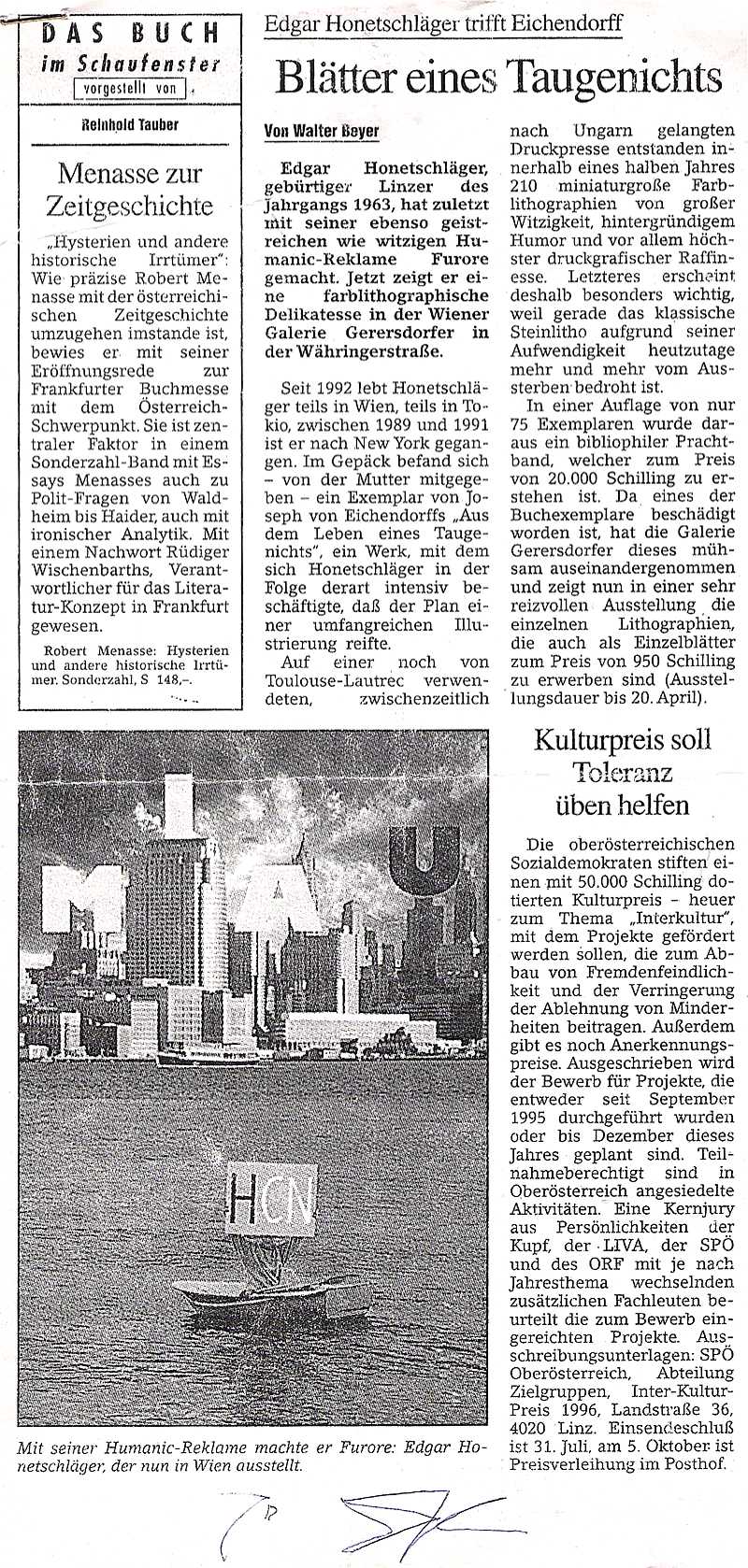
HCN MIAU is an ANAGRAM
The sequence of letters H-C-N, extracted from the company name HUMANIC, can be pronounced like Hudson, the river that, coming from the north, separates mainland America from the west side of Manhattan Island.
Hardly anyone can imagine how difficult it is to find a rowboat in New York in February, the depths of winter. At first it seemed more expensive to rent a boat than to rent a truck for an entire week. After hours of phone calls I finally had success in the Bronx. With two ladies as protection, I drove the next day to a small island in that borough.
In the backyard of a bar where stout gentlemen were enjoying their morning beers, we discovered a somewhat leaky plastic skiff that seemed to be about the right size. Two days later I picked up the boat, with the camera crew packed into the minibus. We strapped it onto the roof and headed off to New Jersey. Weeks earlier I had found an ideal filming location—a spot with the most beautiful view of the skyline. We set up our equipment there. A few small items were missing, so I set out by car to get them. By the time I returned from my odyssey, the camera crew had vanished. The landowner’s security staff had ordered them to leave the premises. It became clear then at the latest that in the United States you need a filming permit for every imaginable place. We drove along the New Jersey coast looking for another location. Every patch of land was fenced off and marked as private property. One sign read: “This parking lot is reserved for students.” My conclusion that it must belong to a university turned out to be correct. I ran up the steps to the campus, asked for security, and charged through the door. In front of me sat a security officer, to whom I babbled something about film school and my thesis project. First he asked whether I’d been raped or if something else terrible had happened, because I sounded so frantic. After I cleared everything up, he told his subordinates that we were under his personal protection and had explicit permission to film the skyline from the parking lot, which lay directly on the Hudson.
Perhaps now is the moment to mention that the temperature was below zero that day. When we finally had everything set up in the biting wind, the actress in position, and I rowing in the boat, the sun went down. The light was no longer strong enough to capture the contrast. We decided to come back the next day. However, we had only rented the car and the boat for a single day. The car could be handled, but what to do with the boat?
If we left it on top of the bus it would surely be stolen, so we agreed to tie it to the dock beneath the parking lot. On the drive home we debated whether the river—which at that spot flows directly into the ocean—would be affected by the tide. The next day we learned that it was indeed tidal, because the boat had sunk, though thankfully it still hung from a thin rope. We hauled it out of the water and discovered that the oars were gone. On the property adjoining the parking lot, a few vagrants were warming their hands by an open fire. When I asked them, they said they had seen one of the oars in the water and promised to fish it out for $10. They had burned the second paddle. But I found an old worn-out broom, which I now used as an emergency oar. Altogether I had to row against the current for four hours just to remain in the same spot on the river. When filming was finally completed, I had blisters on all my fingers and was soaked through. Because the boat leaked, I had, in addition to endless rowing, the task of bailing out the incoming water with a cup. When we retrieved the boat, a young lad who had been watching our work offered to help us. Although I declined, he insisted on helping to pull the heavy boat onto the dock. When we all took shelter from the cold in the car, he demanded money for the service. I offered him $5, whereupon he threw himself on the ground and demanded compensation for a broken back. He yelled that he would sue us. Twenty dollars and a lot of persuasion finally made him drop it. After the shoot, everyone was in bed with the flu for a week.
HCN MIAU New York, 3/1995
HCN MIAU ist ein Anagramm.
Die aus Humanic extrahierte Buchstabenfolge H-C-N klingt ausgesprochen wie HUDSON, jener Fluss, der von Norden kommend das Festland Amerika von der Westseite der Insel Manhattan abgrenzt.
Kaum jemand kann sich vorstellen, wie schwer es ist, im Februar, also zur tiefsten Winterzeit, ein Ruderboot in New York aufzutreiben. Anfangs schien es teurer, ein Boot zu mieten als einen Lastwagen für eine ganze Woche. Schließlich wurde ich nach stundenlangem Telefonieren in der Bronx fündig. Mit zwei Damen als Schutz fuhr ich am nächsten Tag auf eine kleine Insel in jenem Stadtteil.
Im Hinterhof einer Bar, in der korpulente Herren ihr Vormittagsbier genossen, entdeckten wir ein etwas leckes Plastikschinakl, das von der Größe her zu passen schien. Zwei Tage später holte ich jenes Boot, das Kamerateam in den Minibus gepackt, ab. Wir schnürten es aufs Dach und ab gings nach New Jersey. Ich hatte Wochen zuvor einen idealen Drehort entdeckt – d.h. eine Stelle, von der aus die Skyline am schönsten zu sehen war. Dort bauten wir unser Gerät auf. Einige kleine Dinge fehlten, also machte ich mich mit dem Auto auf, um sie zu besorgen. Als ich nach einer Odyssee zurückkamen, war das Kamerateam verschwunden. Der Sicherheitsdienst des Landbesitzers hatte sie zum Verlassen des Geländes veranlasst. Spätestens da wurde klar, dass man in den Vereinigten Staaten an jedem nur erdenkbarem Ort eine Dreherlaubnis braucht. Wir fuhren die Küste von New Jersey entlang, um nach einem anderen Ort zu suchen. Jeder Flecken war umzäunt und als Privatbesitz ausgewiesen. Auf einem Schild war zu lesen: Dieser Parkplatz ist für Studenten reserviert. Meine Schlussfolgerung, dass es sich um Parkplätze für eine Universität handeln musste, stellte sich als richtig heraus. Ich rannte die Stufen zum Campus hinauf, fragte nach dem Sicherheitsdienst und stürmte durch die Tür. Vor mir saß ein übergewichtiger Cop, dem ich etwas von Filmhochschule und Diplomarbeit vorschwafelte. Zuerst fragte er mich, ob ich denn vergewaltigt worden wäre, oder mir etwas anderes Schreckliches zugestoßen sei, da ich so abgehetzt klänge. Nachdem ich alles aufgeklärt hatte, teilte er seinen Untergebenen mit, dass wir unter seinem persönlichen Schutz stünden und ausdrücklich Erlaubnis hätten, vom Parkplatz aus, welcher direkt am Hudson lag, die Skyline zu filmen. Vielleicht ist nun der Zeitpunkt gekommen, darauf hinzuweisen, dass es an diesem Tag 10 Grad minus hatte. Als wir endlich alles in scharfem Wind aufgebaut hatten, die Schauspielerin in Position stand und ich im Boot ruderte, ging die Sonne unter. Das Licht war nicht mehr stark genug, um die Kontraste einzufangen.
Wir beschlossen am nächsten Tag wiederzukommen. Allerdings hatten wir Auto und Boot nur für einen Tag gemietet. Das Auto ließ sich regeln, aber wohin mit dem Boot?
Auf dem Dach des Busses würde es mit Sicherheit gestohlen werden, also kamen wir überein, es am Dock unter dem Parkplatz festzubinden. Noch am Heimweg gab es Diskussionen, ob der Fluss, welcher an jener Stelle direkt in das Meer mündet, wohl von der Flut ergriffen werde oder nicht. Am nächsten Tag lernten wir, dass dem so war, denn das Boot war untergegangen, hing aber Gott sei Dank noch an einem dünnen Seil. Wir hieften es aus dem Wasser, um festzustellen, dass die Ruder verschwunden waren. An dem an den Parkplatz anschließenden Grundstück wärmten sich einige Sandler die Hände am offenen Feuer. Auf meine Frage meinten sie, eines der Ruder im Wasser entdeckt zu haben und versprachen dieses gegen 10$ herauszufischen. Das zweite Paddel hatten sie verbrannt. Doch ich fand einen alten abgenützten Besen, den ich nun in der Not als Ruder verwendete. Ich musste insgesamt vier Stunden gegen die Strömung rudern, um am gleichen Punkt des Flusses zu verharren. Als die Dreharbeiten endlich abgeschlossen waren, hatte ich an allen Fingern Blasen und war durch und durch nass. Da das Boot leck war, hatte ich zusätzlich zum endlosen Rudern die Aufgabe gehabt, mit einem Becher eindringendes Wasser über Bord zu kippen. Als wir das Boot einholten, bot ein junger Amerikaner, der uns bei unserer Arbeit beobachtet hatte, an, uns zu helfen. Obwohl ich sein Angebot zurückwies, ließ er sich nicht davon abhalten, das schwere Boot auf den Steg zu ziehen. Als wir alle vor der Kälte im Auto Unterschlupf suchten, verlangte er Geld für den geleisteten Dienst. Ich bot ihm 5 $, worauf er sich auf den Boden warf und Schadenersatz für einen gebrochenen Rücken forderte. Er brüllte, dass er uns klagen würde. 20$ und viel Überredungskunst ließen ihn davon absehen. Nach dem Dreh lagen alle mit Grippe für eine Woche im Bett.
HCN MIAU New York, 3/1995